TREvolution’s Public Involvement and Engagement Lead, Judith Fisher, uses the experience at the NHS Research Scotland Conference on Patient and Public Involvement and Engagement to take stock on the progress made in the first year of the project.
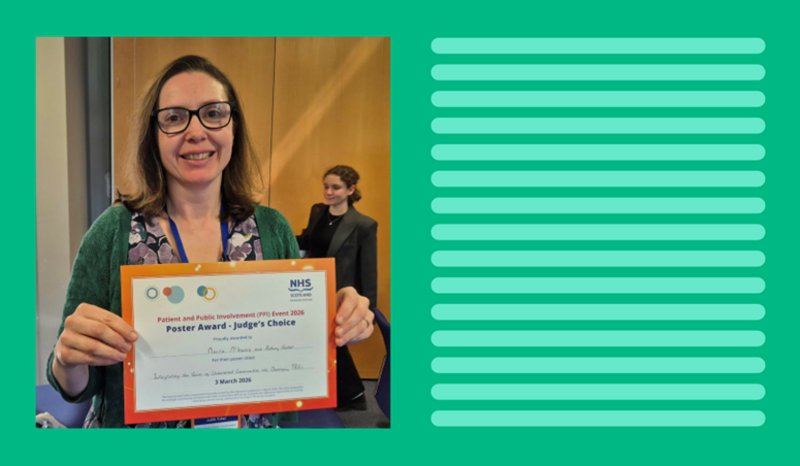
On 3 March 2026, NHS Research Scotland held its annual PPIE (Patient and Public Involvement and Engagement) Conference at the University of Stirling where I presented the multi-layered approach that TREvolution has taken.
For TREvolution we are making sure we hear from as diverse range of communities as possible, to inform the development of our work. The Conference was a great opportunity to speak to people from across the UK, sharing new ideas on how most effectively and inclusively to connect with the public.
Our work with City As Lab to make sensitive data tangible for people in under-served communities attracted a great deal of interest and I was absolutely delighted that the poster received the ‘Judge’s Choice Poster Award’ on the day.
Outputs from the first year
One year into the project, our Public Involvement & Engagement work is well underway. Highlights include:
- Two Public Leads recruited and embedded in TREvolution
- A diverse Public Advisory Group actively engaged across the project
- City as Lab have delivered workshops with participants from under-served communities. Hearing the voices of young people not in education, employment or training, older people and people living in areas of multiple deprivation
- Our Collaboration Café programme, Chaired by our Public Leads, is bringing together stakeholders, including public contributors from across the TRE community, to delve into the technical detail of each element of TREvolution and the impact it has on the wider public
From this range of inputs, a consistent picture of public questions and reservations is starting to emerge. We have identified the following:
Themes from underserved community workshops
The public are looking for:
- Clearer communication on data usage
- Better data input/checking
- Robust data security from human/non-human bad actors
- Non-commercialisation of sensitive data
Questions from Collaboration Cafés
The public are asking:
- Who is accountable for a data breach in a federated system?
- What’s to stop AI entrenching inequalities?
- How can we ensure that members of the public always have a say in whether research is in the public interest?
Next steps
With another year to go, we are looking forward to building on these insights, to ensure the public acceptability of TREvolution’s work. Our next steps will involve:
- Development of wider public engagement work, to take place across the UK, driven by Public Advisory Group and informed by insights from underserved communities workshops
- An on-going Collaboration Café programme, feeding public insights into project workstreams to guarantee that those insights have real impact as we enter the delivery phase of TREvolution
- Increased involvement from our Public Advisory Group, at an individual and group level, at each point in TREvolution’s work
I’m looking forward to the year ahead, as we share the insights the public have shared with us across the TREvolution team and see the difference that taking such a comprehensive approach to public involvement and engagement will have on ensuring that the interests of the public remains at the centre of sensitive data research.
About TREvolution
TREvolution is a programme of work shaping the future of sensitive data research in the UK by promoting shared standards and building trustworthy innovations to make research faster and more effective for the public good. Public involvement and engagement is at the heart of this work, making sure everything we do is open, inclusive, and shaped by what matters to people. One of the key ways we do this is through our workshops, where we bring people together to share ideas and shape the direction of our work.