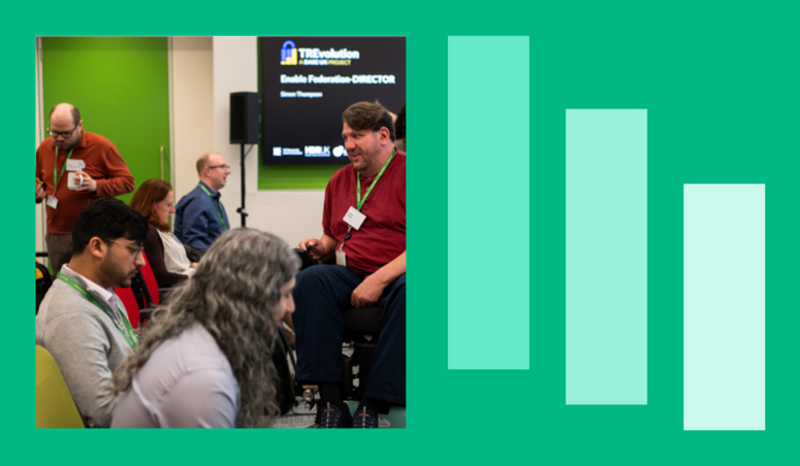
It was great to gather in London in April to celebrate the first anniversary of TREvolution and reflect on how much progress we’ve made since the launch in March 2025.
TREvolution is more than the sum of its parts, and it’s worth pausing to remember how this ambitious programme of work has been brought together.
TREvolution is funded via UK Research and Innovation to addressing challenges associated with enhancing data access and analysis between Trusted Research Environments (TREs) – secure environments where approved researchers can access sensitive data for research in the public benefit, such as national public health and population-level surveys.
TREs in the UK are internationally renowned. But the pace in technology change makes it challenging for TREs to keep up with today’s scientific needs, like federation, analysis across sectors and research domains, or to facilitate research whilst maintaining standards in disclosure control and large-scale studies.
The first phase of DARE UK funded a series of Driver Projects, which were completed in 2023, and looked at addressing some of these emerging challenges for TREs. Five of the six Driver projects were folded into the TREvolution programme with the aim to connect TREs across the UK seamlessly and safely.
One year into the work, TREvolution is coalescing around four key pillars which supporting better research that benefits society:
- Adopt standards
- Build trust
- Enable federation
- Accelerate research
TREvolution is led by five UK research institutions: University of Nottingham, University of Dundee, University of Manchester, University of the West of England, and Swansea University*.
Across these institutions and partner organisations, the programme brings together multidisciplinary teams and experts from a range of backgrounds, including computer science, data analytics, and public involvement and engagement.
What are the four pillars?
The very nature of data research is complicated, and the system is fragmented. As much as we have a duty to simplify the system to enable seamless research, we also need to be better at telling the story of why this is important. This is what our public contributors are asking for — clearer communications. The four pillars help us to tell this story.
Adopt standards
Rather than starting from scratch, we are focused on adopting existing standards that can be used to build trust and enable federation. There are three projects underway in this theme – they all demonstrate that these standards are suitable, relevant and appropriate to be used to enable federation to access or analyse data across multiple TREs.
Build trust
Trust is the cornerstone of sensitive data research. Without it, collaboration stalls, public confidence weakens, and the potential of data is left unrealised. There are three key areas of work under this theme. The Standardised Architecture for Trusted Research Environments (SATRE) specification provides a framework for TREs – this past year, the team sought engagement from users and the public to produce a new version, which launched this July.
Our innovative approach to public engagement is recognised as sector-leading, with a multilayered approach to engaging with a diverse range of audiences. This includes working with the City as Lab to engage the public from underserved communities, such as young people, about data science. Transparency between users is also crucial to building trust, and the Five-Safes RO Crates project is packaging metadata (data about data) needed for exchanging research requests and results between analysis tools and TRE providers, enabling them to operate Five Safes-compliant processes.
Enable federation
TREvolution is working towards new ways for TREs to work better together and make research involving data from multiple locations and disciplines less challenging for the researcher. Inoperability – the ability of one TRE to ‘talk’ to another – introduces more complexity and requires a new operational model.
TREvolution has two projects under this theme. Director is a product that is being developed to assist with the operational aspects of providing federation. It manages and configures the connections between the TREs to enable the project. Patterns and Weaves are frameworks that capture the many components that are required for the many different types of analyses that can be performed over a federated network.
Accelerate research
TREvolution’s overarching goal is to enable faster, safer and more impactful research that benefits society. By adopting standards, building trust and enabling federation, we’re creating the conditions for sensitive data research to move more quickly while maintaining the highest standards of security. The Semi-automated Checking of Research Outputs and Support for AI (SACRO) piece supports this objective through a tool that can help speed up the output-checking process and modernise the well-regarded Five Safes framework.
Test, listen, refine
Each product developed as part of TREvolution was tested by a series of early adopter projects. The DARE UK Early Adopters were pioneering projects that complemented TREvolution by integrating, testing and refining key technical products designed to enhance TRE research capabilities for public benefit. Each early adopter project focused on specific areas of TRE enhancement. This includes the SATRE reference architecture, federated analysis, semi-automated output checking and disclosure control, and AI-readiness, ensuring that the TREvolution products are secure, practical, scalable, and ready for broader adoption by data research infrastructures and services in the UK.
We also have the DARE UK Research Exemplars, real-world research projects exploring innovations enabling:
- Federated data access across multiple TREs
- Distributed analytics pipelines that run securely across environments
- Enhanced disclosure control for AI and machine learning outputs
- Secure connections to advanced computing infrastructure
- Cross-sector data linkage combining health, environmental and geographic datasets
The key to all of these products is using them in the wild in a safe way and testing how they work, finding their limitations and improving them to work better. The reality of real-world research environments brings to light different considerations and helps us to hone in on how we can accelerate research for public benefit.
Bridging the gap
We know that co-design is essential and collaboration between different TREs is necessary to address inoperability. TREs set the context in which the research can occur, but it needs to work for users and that involves engaging with both camps. TREvolution is helping to develop products that can reduce burden and speed up processes while still maintaining security. There is a tension between the desire to be secure and having good governance in place, and finding a balance so researchers can proceed with gathering data in a straightforward way. TREvolution is helping to bridge that gap.
This helps us to do more advanced research for public benefit at a national scale through access to data from multiple sources, which means more representation and richer insights to help solve some of our biggest challenges – mental health, dementia and climate change – to name just a few. DARE UK’s 2024 scientific use cases workshop report highlights the social and economic opportunities that could be unlocked through a trustworthy, connected UK data research infrastructure.
Alongside the real-world research exemplar projects, we are looking beyond the UK. Our work is being embraced in Europe (EOSC-ENTRUST), Singapore, Australia and South America, which puts the UK at the forefront of sensitive data research and innovation.
Watch out for further announcements as the programme continues at pace.
* In collaboration with Durham and Lancaster Universities, Lancashire Teaching Hospitals, NHS Scotland, Nottingham University Hospitals NHS Foundation Trust, and international Universities of Queensland, Basel and Cape Town.