The TRESS project is exploring how universities can share software, governance and expertise to make Trusted Research Environments (TREs) easier to develop, operate and sustain. If universities can confidently share software, governance and good practice, they can reduce duplication, accelerate innovation and make secure research infrastructure more sustainable.
TREs provide secure places where approved researchers can analyse sensitive data without compromising privacy or security. Many organisations are building these environments independently, often solving the same technical and governance challenges more than once. TRESS (The Trusted Research Environment Software Stewardship) explores how institutions can share trusted approaches while still meeting their own local operational, legal and security requirements.
TRESS is led by the University of Oxford and University College London in partnership with the Thames Valley and Surrey Secure Data Environment, working closely with the Oxford Trusted Research Environment (OxTRE) and supported through the DARE UK Next-Gen Catalysts programme.
By exploring software stewardship and shared governance for TREs, it ensures software remains trusted, shared and continually improved through documentation, governance and collaboration. The project is also developing a shared Information Security Management System (ISMS), which are the policies, processes and controls that help organisations manage information securely, adapted by different institutions while maintaining a consistent foundation.
What does TRESS aim to achieve?
By the end of the project, the TRESS aims to demonstrate that TRE software and governance can be shared across institutions without compromising local flexibility or security. Goals include:
- Build a shared research ecosystem – develop a shared approach to TRE delivery across multiple universities.
- Streamline governance – create a reusable ISMS that organisations can adapt to their own operating arrangements.
- Strengthen software sustainability – demonstrate effective software stewardship by enabling institutions to jointly develop, maintain and improve TRE software.
- Apply to real-world questions – test the shared approach through real research projects and capture practical learning for the wider sector.
Progress so far
Like any new partnership, our collaboration has involved learning how each organisation works. University College London and the University of Oxford have different cultures, processes and levels of maturity in delivering central TRE services. Bruce Tuckman’s “forming, storming, norming and performing” model of team development describes this journey well. We have been fortunate to experience minimal “storming”; instead, we’ve concentrated on building relationships, understanding each other’s ways of working and developing the trust needed to jointly steward security-critical infrastructure.
A key learning to date is that software stewardship involves much more than maintaining software. It also requires shared documentation, governance, knowledge transfer and clear ownership.
Within the first six months, the TRESS team has:
- Worked closely with University College London colleagues to understand the existing TRE platform and establish Oxford development and staging environments based on the shared codebase. We’ve established a reliable method to allow both institutions to contribute to, and receive up-to-the-minute features and fixes to, the shared Infrastructure-as-Code source, going beyond open-source patterns relying on patch releases, while maintaining institutional contextual differences.
- Progressed the development of a shared ISMS, creating a common framework that each institution can tailor to reflect its own governance and operational requirements. Like the shared TRE software, the ISMS can be reused while allowing local adaptation.
- Engagement with researchers to identify suitable demonstration projects.
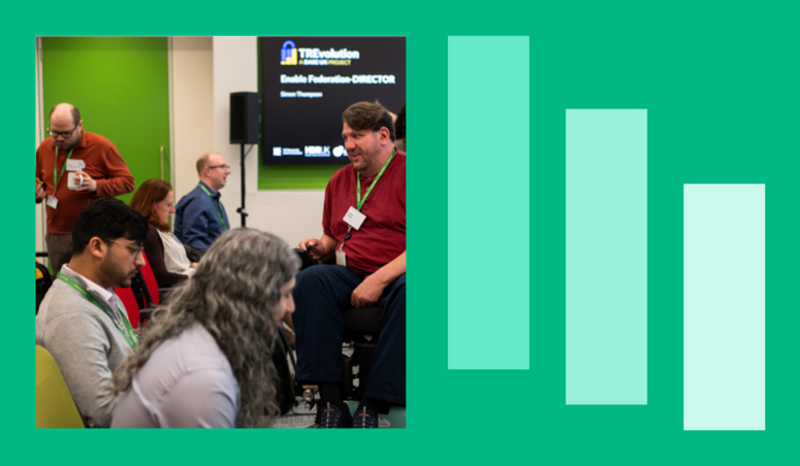
- Shared our work through presentations across the sector and hosted a public engagement session during Love Research Data Week 2026 and discussing the importance of TREs. These conversations reinforce that successful adoption depends as much on people as technology.
During the second half of the project, we will onboard demonstration projects, showcase jointly developed TRE features, test the shared governance approach and continue sharing our learning. We are also planning a further engagement event in London this autumn to showcase progress and encourage new collaborations.
Relevance to the DARE UK vision
TRESS explores practical ways for organisations to share trusted research infrastructure rather than developing everything independently. By combining software stewardship with shared governance, the project is generating evidence about how TREs can become more sustainable, interoperable and easier to adopt. Aiming for future projects to build not only better software, but stronger partnerships and greater public trust.
About the DARE UK Next-Gen Catalysts
The DARE UK Next-Gen Catalysts are early-stage, exploratory projects developing and testing the next generation of capabilities for Trusted Research Environments (TREs) across the UK. Bringing together researchers, technology specialists, public contributors and other partners, these projects explore bold new ideas that could expand how sensitive data is accessed, analysed and governed while maintaining privacy, security and public trust. Their role is to generate evidence, prototypes and practical learning that can help shape the future of secure, trustworthy data research for public benefit.