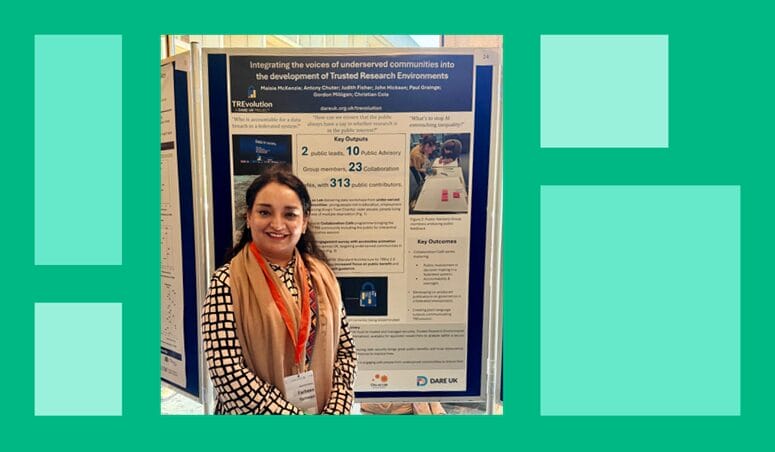
Farheen Yameen, member of TREvolution’s Public Advisory Group, attended International Population Data Linkage Network (IPDLN) Conference in Rotterdam this summer. Farheen writes about her experience attending the conference to represent TREvolution and support the presentation of work she has been involved in.
In July 2026, I had the opportunity to attend the IPDLN Conference in the Netherlands as a public contributor.
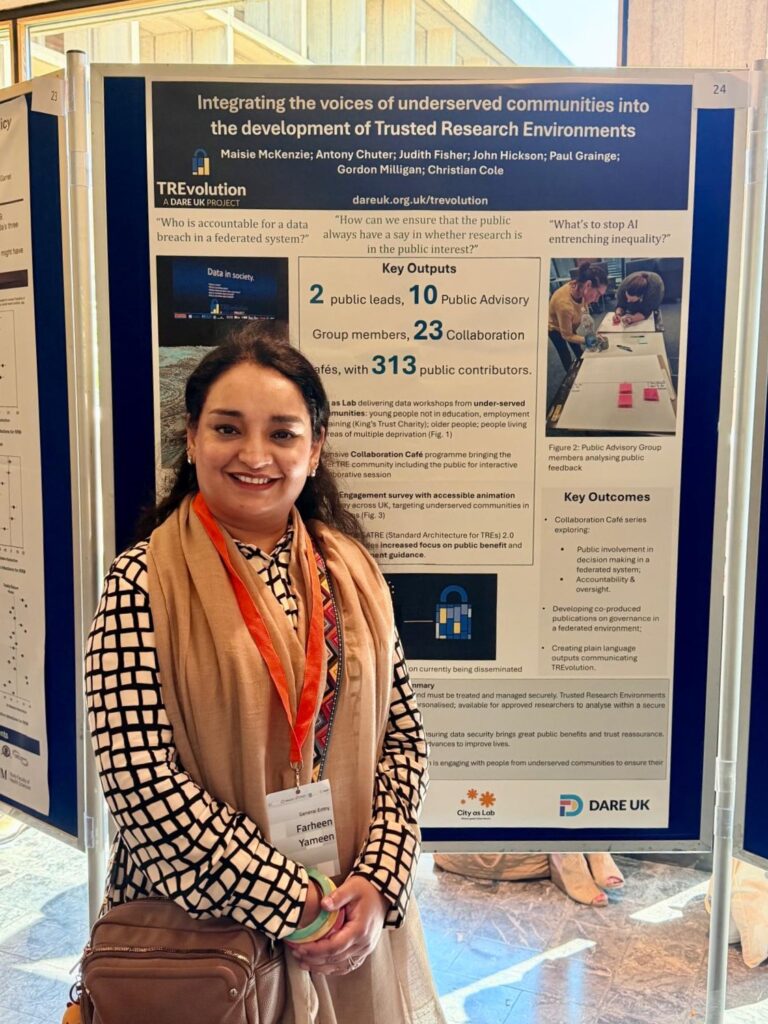
I was particularly happy to be there for the TREvolution poster presentation, where I could see the work which our Public Advisory Group had contributed to being shared with researchers and other people from different backgrounds.
One of the highlights for me was seeing the TREvolution poster featuring at the conference and the poster was about ‘Integrating the voices of underserved communities into the development of Trusted Research Environments’.
What really stood out to me was the focus on making sure that people who are often not heard in research are included in discussions about data.
One of the biggest things I learned is that data is not just numbers. Behind every piece of personal data is a real person, a family and a life.
Standing next to the TREvolution poster was a proud moment for me because seeing the work presented at an international conference made me feel that the voice of the public really can make a difference. It also made me feel proud of the journey I have taken as a public contributor.
When I first became involved in research, there were many terms and concepts that were completely new to me. Now I find myself discussing things like data linkage, Trusted Research Environments and public involvement with researchers that has been a big learning journey for me.
I hope my involvement can continue to help researchers think about their work from the perspective of ordinary people and different communities.
Further information
TREvolution is a programme of work shaping the future of sensitive data research in the UK by promoting shared standards and building trustworthy innovations to make research faster and more effective for the public good.